

Drama
Ebenezer (12A)

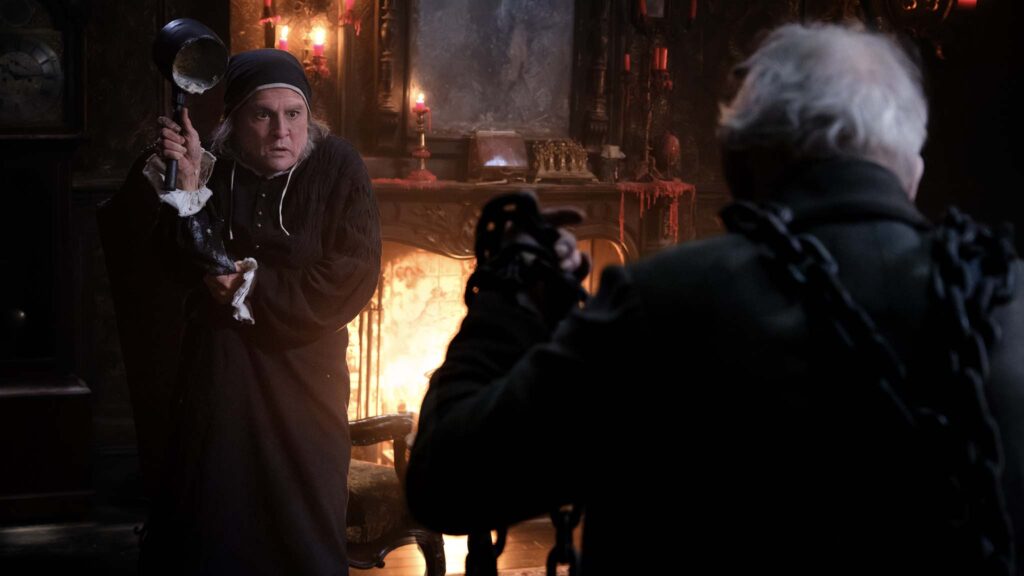
Review: Ghostly hauntings, a spooky graveyard reckoning, the death of a sickly child, misery and creeping dread. Charles Dickens’ A Christmas Carol is a horror story and Ti West, director of the X trilogy (X, Pearl, MaXXXine), is a snug fit for this twisted reinterpretation of the redemption story, casting a typically idiosyncratic Johnny Depp as the eponymous penny-pinching miser. Tidings of discomfort abound in Nathaniel Halpern’s script, which says bah humbug to seasonal sentimentality, conjuring scenes that could be unsettling for very young children, including the fatal stabbing of a beloved character that never appears on the page.
In 1836 London, Ebenezer Scrooge (Depp) and business partner Jacob Marley (Sir Ian McKellen) are kindred spirits when it comes to kindness and compassion at Christmas. “Good cheer does not help to balance a ledger,” notes Ebenezer. Hard-working clerk Bob Cratchit (Rupert Grint) suffers the duo’s bile-slathered tirades to provide for his wife and children including Tiny Tim (Freddie Lee-Grey). Meanwhile, Scrooge rejects annual invites from his nephew Fred (Sam Claflin) to join him and wife Clara (Daisy Ridley) for their Yuletide celebration.
Marley dies and only Scrooge attends the burial. On Christmas Eve, the chain-rattling spectre of the late business partner visits Scrooge at home and heralds the arrival of three apparitions, who could prevent Ebenezer from suffering a similarly lonely fate. As a clock strikes one in the morning, the Ghost of Christmas Past (Andrea Riseborough) materialises, followed on subsequent chimes by the ghosts of Christmas Present (Tramell Tillman) and Christmas Yet to Come (Robert Strange). These lingering phantoms open Scrooge’s squinty eyes to the repercussions of his mean-spirited actions and confront him with scenes from his youth when a young Ebenezer (Arthur Conti) foolishly put his career ahead of romance with aspiring writer Belle (Ellie Bamber).
Ebenezer spikes the festive spirit with generous glugs of ghoulishness and despair. West’s film could stray even more boldly into horror territory but that would mean sacrificing the family-friendly 12A certificate. The filmmaker engineers a couple of mild jump scares and takes sadistic delight in imagining fog-shrouded streets of pre-Victorian London awash with legions of demented ghosts and a screaming mouth stretching wide to disgorge a live animal. He also buries the title character alive, hands bursting out of freshly dug soil to claw at terrified living flesh. Riseborough’s embodiment of the first ghost is haunting in every sense.
Depp’s theatrics kindle sparks of comedy while co-stars play their roles with seriousness and straight-faced sincerity. Grint furiously plucks heartstrings in a centrepiece confessional and Claflin mines the deep emotional core of his warm-hearted relative, who doesn’t want to give up on Ebenezer because it’s what his late mother would have wanted. Pervasive darkness comes at the expense of an unabashed final feelgood kick. There is certainly hope but it’s frost-bitten and takes almost two hours to thaw.
Find Ebenezer in the cinemas
Action
How To Rob A Bank (15)



Review: The energy is consistently high in Bullet Train director David Leitch’s action-packed crime caper, which unfolds through the lenses of multiple handheld, mounted, static and drone cameras used by a gang of Robin Hood-style bank robbers, who proudly document their illegal activities on a successful YouTube channel. Editor Elisabet Ronaldsdottir ricochets at dizzying speed between these competing points of view, visualising robberies as hyperkinetic finished online posts replete with overlaid gifs, captions and comical sound effects.
Ryan (Nicholas Hoult) is the ringleader of the Who’s Hungry crew comprising his partner Emi (Anna Sawai) and good friends Hugo (Rhenzy Feliz) and Vince (Pete Davidson). They wear animal masks and live stream their exploits on their channel to more than 1.2 million subscribers. The group has successfully targeted 15 banks over the past three months and taunts the FBI with viral videos, accumulating more than 900 million views with recordings of the authority-defying antics.
FBI special agent John West (John C Reilly) is determined to outwit the Who’s Hungry crew and he recruits Reagan Gardner (Zoe Kravitz). She is under house arrest for developing a system that combines facial recognition technology with proprietary algorithms to scout the web and social media channels to track down anyone in the world. In the wrong hands, her invention could be weaponised to mercilessly snuff out dissent. Reagan agrees to use her high-tech skills to track down the criminals in exchange for dropping the charges against her. She is impressed with the Who’s Hungry squad’s altruistic thievery. “It’s punk!” she gushes. Meanwhile, Agent West reflects on why he pursued a career in law enforcement: “I became an FBI agent because I love the movie Point Break.” That film didn’t end happily for the authorities.
How To Rob A Bank is a flashy tale of beleaguered cops and quick-witted robbers that dresses up a familiar “stick it to the man” plot with filmmaking verve. Reilly’s odd couple dynamic with Kravitz feels slightly contrived but they are necessary comic relief from the grief and rage that gradually bubbles to the surface as personal vendettas are exposed. Screenwriter Mark Bianculli invests sufficient time fleshing out back stories of the four robbers to explain why they have been “driven” to a life of crime to make us root for their righteous, rabble-rousing rogues in the David vs Goliath battle with corporate behemoths. Davidson has the strongest narrative arc in this respect and milks genuine tears when desperate times call for drastic measures.
Christian Slater has a small but pivotal role as a slippery manager of one of the banks with top-notch security that has, thus far, defied the gang’s meticulous planning. Leitch’s pedal-to-the-metal approach to action sequences is both invigorating and exhausting. Stealing our attention then holding it, requires a tighter grip.
Find How To Rob A Bank in the cinemas
Drama
Prima Facie (15)



Review: Around one in three women will suffer physical and/or sexual violence in their lifetime. Roughly one in 10 of those women will report sexual violence to the police and of those cases, only one in 10 results in a conviction. Those sobering statistics buttress Susanna White’s underwhelming screen adaptation of Suzie Miller’s award-winning one-woman play, which featured Jodie Comer when it premiered in London in 2022. Expanded for the screen by Miller, Prima Facie puts manifold shortcomings in our legal system under a microscope and issues a tub-thumping call to arms for change to better protect women who do come forward and have no choice but to put their private lives on trial to achieve justice.
Tessa Ensler (Cynthia Erivo) is a brilliant young barrister operating out of the Old Bailey in London, who has steadily risen through the ranks of the British legal system from humble beginnings near Tilbury Docks in Essex. She secured a scholarship to study at Cambridge and is determined to make proud her mother, June (Noma Dumezweni), who works as a cleaner, and younger brother Johnny (Toheeb Jimoh), who is poised to become a father for the first time.
Cool and calm under pressure, Tessa has gained a reputation for successfully defending men accused of sexual assault and her impressive results have caught the eye of a venerated peer (Simon Russell Beale). “People are fallible and their words have to be tested, especially when someone’s freedom is at stake,” she calmly explains to a junior after her latest “not guilty” verdict.
Tessa’s moral compass recalibrates when she begins dating colleague Julian Brooks (Daniel Ings), who harks from privileged stock. She falls ill during a booze-soaked date and in the early hours of the morning, Julian forces himself upon Tessa without her consent. Now, Tessa must have faith in the same justice system that she manipulates to prove her version of events beyond a reasonable doubt. “How can I continue to be a barrister if I don’t believe in it myself?” she sombrely reflects.
Prima Facie couldn’t be more timely and Miller’s script makes compelling arguments about the law’s duty to support victims but the film version extinguishes the fire and fury that raged ferociously on stage. Erivo is deeply moving in the central role but the internal monologues that worked so well in a live setting lose their power as exposition on a big screen. Pacing plods and when a caption appears revealing that Tessa will give evidence in court 1,107 days after the assault, we, as an audience, feel the sluggishness of the clunky resolution. A grandstand courtroom finale is promised but never delivered.
Find Prima Facie in the cinemas