

Popular on LondonNet
– Beatles in London Home
– Abbey Road
– London Day Trip
– Liverpool
– Beatles Memorabilia
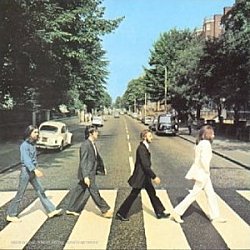
Without a doubt, the most famous location in Beatles history, both visually and sonically, is the former EMI studios, where the Beatles recorded nearly all their songs, at 3 Abbey Road in St. John’s Wood, just northwest of central London. More specifically, the zebra crossing just outside those studios is to this day one of the biggest tourist attractions in all of London.
The unassuming two-lane street and crossing seem normal enough. If it hadn’t been the backdrop of the most recognizable image of the most recognizable band in pop music history, it would most likely be just another wavy line on the spider web that is London’s streets.
But it was that backdrop. As a result, the zebra is now the destination of an endless stream of pilgrims, almost all with a markedly humble goal – scoring the perfect photo of themselves and three friends walking indifferently, mid-gate across the street. There’s even a 24-hour live video stream of the cross walk on the internet so that anywhere in the world, you can have your mates watch as you do your best Macca. Anyone driving Abbey Road often couldn’t help but curse whomever decided UK traffic law would give the right-of-way to the pedestrian at cross walks.
But in visiting Abbey Road today, one does not visit the iconic, warm August 1969 afternoon that the famous album cover art displays. The street’s slow, gradual turn to a distant vanishing point on the album’s cover is not nearly as romantic in person. Several visitors have done double takes trying to decide which direction down the street the album’s photo is actually looking. There is no classic Volkswagen, no simple street paint, no bare-footed, bearded, or otherwise notable Scousers. It is what it is, not what it was – a moderately busy two lane street that just happened to become the center of the musical universe four decades ago. And that in itself should be more than enough to appreciate, with or without your shoes on.
– Patrick Allegri